
USDT TRC20 Withdrawal Fee: Exchange Fee vs TRON Network Fee
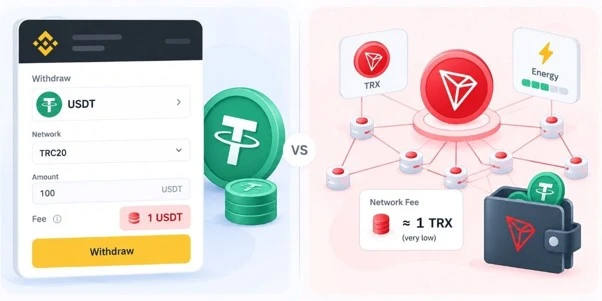
Most large exchanges charge a flat fee of roughly 1 to 1.5 USDT to withdraw USDT on the TRON (TRC20) network, and the fee is deducted from the USDT you withdraw. That fee is set by the exchange, not by TRON, and it is the only cost you pay on a withdrawal. The on-chain TRON network fee, paid in TRX or covered with Energy, only applies when you send USDT yourself from a wallet you control, including when you deposit back to an exchange.
This guide separates the two fees, shows what the main exchanges charged when we checked, and explains the one situation where renting TRON Energy actually saves you money.
Two different fees with the same name
People search for “USDT TRC20 fee” and get answers that range from 1 USDT to 13 TRX. Both numbers can be correct. They describe two different charges:
| Exchange withdrawal fee | TRON network fee | |
|---|---|---|
| Who sets it | The exchange | TRON network parameters |
| Who pays it | You, when you withdraw from the exchange | The wallet that signs and sends the transaction |
| Paid in | USDT, deducted from the withdrawal | TRX burned, or Energy and Bandwidth consumed |
| Typical amount | About 1–1.5 USDT, flat | About 6.5 TRX, or about 13 TRX to an address with no USDT, if no Energy is used |
| Can Energy reduce it? | No | Yes |
The amount of USDT does not change either fee. Withdrawing 20 USDT and withdrawing 20,000 USDT usually costs the same flat exchange fee, and the TRON network does the same amount of work for both. That matters most for small withdrawals: a 1 USDT fee is 5% of a 20 USDT withdrawal but 0.05% of a 2,000 USDT one.
What exchanges charge for USDT TRC20 withdrawals
Exchanges do not all publish a fixed TRC20 figure. Some show the fee only on the withdrawal screen, and most say it can change without notice. The table below shows what was published or reported when we checked. Use it as a guide, then confirm the number on the withdrawal page before you submit.
| Exchange | USDT TRC20 withdrawal fee | Notes |
|---|---|---|
| Binance | About 1–1.3 USDT | Shown on the withdrawal page; Binance does not publish a fixed figure. Reported minimum 5–10 USDT. |
| OKX | 1.5 USDT | Listed on OKX’s fee page in early October 2026, with a 10 USDT minimum withdrawal. |
| Bybit | About 1 USDT | Bybit states its withdrawal fee is fixed regardless of amount. |
| Kraken | About 1–2.5 USDT | Fee trackers report different figures; check Kraken’s withdrawal screen. |
| Coinbase | Not available | Fee trackers report that Coinbase does not support USDT withdrawals on TRON. |
Figures checked October 2026. Official sources: Binance withdrawal fees and Kraken fee schedule. VIP or trading-tier discounts on an exchange usually apply to trading fees, not to withdrawal fees, so check before assuming a discount.
Why the exchange fee is not the network fee
When you withdraw, the exchange signs and broadcasts the transaction from its own hot wallet. It pays whatever the TRON network charges for that transaction, and it charges you a separate flat price for the service. That price is a business decision. It covers the exchange’s on-chain cost, its wallet operations and a margin, and it stays the same whether the exchange paid for the transfer with its own staked TRX, rented Energy or burned TRX.
This is why the exchange fee is rounded to a tidy USDT number and moves rarely, while the on-chain cost moves with TRON’s resource prices and the USDT contract’s Energy consumption. It is also why a failed withdrawal is the exchange’s problem: you see a pending or rejected withdrawal, not an Out of Energy error.
What the TRON network fee is
The network fee is what TRON charges the sending wallet to run the USDT smart contract. It is paid with two resources: Bandwidth for the transaction data and Energy for the contract execution. If the wallet has no Energy, TRON burns TRX instead, at 100 SUN per unit of Energy. A transfer to an address that already holds USDT needs roughly 65,000 Energy (about 6.5 TRX if burned), and a transfer to an address with no USDT balance needs roughly twice that. For the details and how to estimate your exact shortfall, see how much Energy a USDT transfer needs.
Bandwidth is separate. Every activated TRON address gets 600 free Bandwidth points per day, which is enough for about one USDT transfer of roughly 345 points. Beyond that, TRON burns about 0.345 TRX per transfer for Bandwidth.
Can renting TRON Energy lower an exchange withdrawal fee?
No. The exchange is the sender, so the transaction uses the exchange’s resources, not yours. Delegating Energy to your own wallet, or to the receiving address, does not change the fee the exchange deducts. Any TRON Energy provider that suggests otherwise is describing something that does not happen on-chain.
Renting Energy also does nothing for a withdrawal that is stuck. If an exchange withdrawal is pending, the fix is on the exchange side; contact its support with the withdrawal ID.
Sending from your own wallet is where Energy helps
Once the USDT is in your own TRON wallet, every outgoing transfer makes you the sender. That is the point where you choose how to pay the network fee: burn TRX, use Energy from staked TRX, or use delegated Energy. For occasional transfers, delegated Energy is usually the cheapest of the three, because you pay a market price for Energy instead of the network’s 100 SUN burn rate. You can rent TRON Energy for the sending wallet before you sign the transfer, and the Energy must be visible on that wallet first.
If you are new to this, follow the step-by-step guide to sending USDT from your own wallet. It covers the order of steps that prevents most failed transfers.
Depositing USDT to an exchange
Exchanges generally do not charge a fee to receive a USDT deposit. The network fee is still paid, but by you, because your wallet sends the transaction. Three details catch people out:
• The deposit address may hold no USDT. Many exchanges move deposits from your personal deposit address into their main wallets. If TronScan shows the deposit address currently holds 0 USDT, plan for the higher Energy amount, not the 65,000 figure. Check the address and estimate with the TRON Energy Calculator before sending.
• Energy goes to your wallet, not the deposit address. Delegating Energy to the exchange’s address does not cover your transfer. The wallet that signs needs the Energy.
• Check the minimum deposit. Exchanges set a minimum amount they will credit. A deposit below it may not appear in your balance even though the network fee was paid.
If a deposit fails on-chain with FAILED – OUT OF ENERGY, the USDT normally stays in your wallet, but the attempt still costs resources. The Out of Energy error guide explains how to check and retry safely.
Worked example: exchange to wallet to supplier
Say you withdraw 500 USDT from an exchange to your TronLink wallet, then pay a supplier whose address already holds USDT. Using a TRX price of about $0.33 and prices seen in October 2026:
| Step | Who pays | Cost |
|---|---|---|
| 1. Exchange withdrawal | You pay the exchange | About 1–1.5 USDT, deducted from the 500 USDT |
| 2a. Wallet to supplier, burning TRX | Your wallet | About 6.5 TRX (≈ $2.15) + Bandwidth if the daily free points are used up |
| 2b. Wallet to supplier, with rented Energy | Your wallet | 65,000 Energy at 35 SUN ≈ 2.3 TRX (≈ $0.75) |
The withdrawal fee is fixed whatever you do. The second step is the one you control, and it is often the larger cost. Paying with rented Energy instead of burning TRX saved about 4 TRX on this one transfer. Over many transfers the difference grows; the Energy vs burning TRX comparison shows when each option makes sense.
How to pay less on USDT TRC20 withdrawals
• Withdraw less often, in larger amounts. The fee is flat, so one 1,000 USDT withdrawal costs a fifth of five 200 USDT withdrawals.
• Check whether you need an on-chain transfer at all. If the recipient uses the same exchange, its internal transfer feature is often free because nothing is sent on-chain.
• Compare networks on the withdrawal screen. On some exchanges another network is cheaper than TRC20 for USDT, but only if the recipient supports it. Sending on the wrong network can lose funds. Read how TRON and Ethereum fees compare before switching.
• Watch the minimum. Withdrawals below the exchange minimum are rejected, and a flat fee on a tiny amount is a large percentage.
• Send a small test first to a new address or a new exchange. A 1 USDT fee on a test is cheaper than a mistake.
• Use Energy for everything you send from your own wallet, including deposits back to the exchange.
Frequently Asked Questions
How much is the USDT TRC20 withdrawal fee?
On most large exchanges it is a flat amount of about 1 to 1.5 USDT per withdrawal. The exact figure is shown on the exchange’s withdrawal page and can change without notice.
Is the withdrawal fee paid in USDT or TRX?
In USDT. The exchange deducts it from the amount you withdraw. You do not need TRX in your exchange account to withdraw USDT on TRC20.
Does the fee depend on how much USDT I withdraw?
Usually not. Most exchanges charge the same flat fee for any amount above the minimum, which makes small withdrawals relatively expensive.
Do I need TRX in my wallet to receive a USDT withdrawal?
No. The sender pays the network fee. Your wallet needs no TRX and no Energy to receive USDT. You only need resources when you later send it.
Why did my wallet pay about 13 TRX to deposit USDT to an exchange?
The deposit address probably held no USDT at that moment, which roughly doubles the Energy the transfer needs. With no Energy in your wallet, TRON burned TRX for the full amount.
Can I avoid the withdrawal fee completely?
Only by not making an on-chain withdrawal, for example by using an exchange’s internal transfer when the recipient is on the same exchange, or during a promotion the exchange runs. Any on-chain TRC20 withdrawal has a fee.
Related Guides
How to Send USDT on TRON Without TRX for Network Fees
Learn how to send USDT on TRON without burning TRX for network fees by using TRON Energy. Check the required Energy and reduce TRC20 transfer costs.
Best TRON Wallets for TRX, USDT and Energy Management
Compare five TRON wallets for TRX, USDT and Energy management: TronLink, SafePal, imToken, Trust Wallet and Ledger with TronLink.
How Much Energy Does a USDT Transfer Require on TRON?
A TRON USDT transfer commonly needs about 65,000 or 131,000 Energy. Learn what determines the amount and how to estimate your shortfall.
How to Delegate TRON Energy with Stake 2.0
Learn how TRON Stake 2.0 resource delegation works, which resources can be delegated, wallet requirements, lock periods and how to undelegate safely.