
How to Reduce TRC20 Fees: 3 Proven Ways to Cut USDT
TRON is widely used for USDT transfers because it is fast and usually cheaper than many alternative networks. But a TRC20 transfer is not automatically free. If your wallet does not have enough network resources, TRX is burned to pay for the missing Energy and Bandwidth.
For someone sending USDT once, that cost may be acceptable. For a trader, freelancer, payment team or business making repeated transfers, it becomes an operating expense.
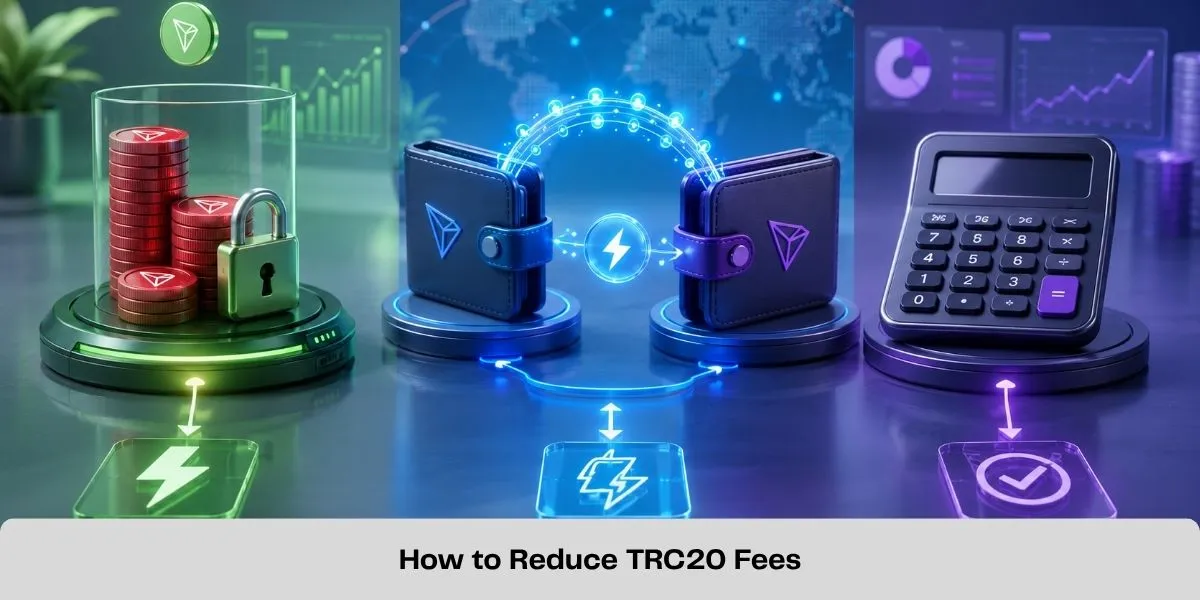
The practical answer to how to reduce TRC20 fees is to stop treating every transfer the same. You can stake TRX for recurring Energy, rent delegated Energy when you need it, or estimate the transaction before sending so you do not pay for avoidable failures or resource shortages.
This guide explains how each method works, who it suits and what to check before your next USDT transfer.
Why TRC20 USDT Transfers Require TRX or Energy
Every transaction on TRON consumes Bandwidth. Smart-contract transactions also consume Energy.
A native TRX transfer mainly uses Bandwidth. Each account currently receives a limited daily allowance of free Bandwidth, and additional Bandwidth can be obtained by staking TRX. A TRC20 USDT transfer is different because it calls the USDT smart contract. That contract execution requires Energy as well as Bandwidth.
Your wallet can cover this requirement in three ways:
- Use Energy obtained by staking TRX.
- Use Energy delegated from another account.
- Burn TRX to pay for any Energy or Bandwidth that is missing.
If sufficient Energy is available, the network consumes that resource first. If it is not available, the network calculates the shortfall and burns TRX according to the current resource price. If the wallet cannot cover the required resource cost, the transaction can fail while still consuming resources used during the attempt.
For a deeper explanation of the resource system, see TRON Energy and Bandwidth.
How Much Does a TRC20 USDT Transfer Cost?
There is no permanent flat fee for every USDT transfer. The Energy requirement can change according to the USDT contract's current energy_factor, network parameters and the storage state of the recipient's USDT balance.
Official TRON documentation gives the following approximate magnitudes:
| Transfer condition | Approximate Energy requirement | Approximate TRX burned at 100 sun per Energy* |
|---|---|---|
| Recipient already has a USDT balance | Around 64,000 Energy | Around 6.4 TRX |
| Recipient has no USDT balance | Around 130,000 Energy | Around 13 TRX |
\*The calculation illustrates the resource cost only. Actual consumption and network parameters can change. Account activation, Bandwidth shortages, wallet behavior and other transaction conditions may add costs.
The amount of USDT being transferred is usually not the main cost driver. Sending 20 USDT and 2,000 USDT can require similar contract execution. The recipient's state and the resources available in the sending wallet matter more.
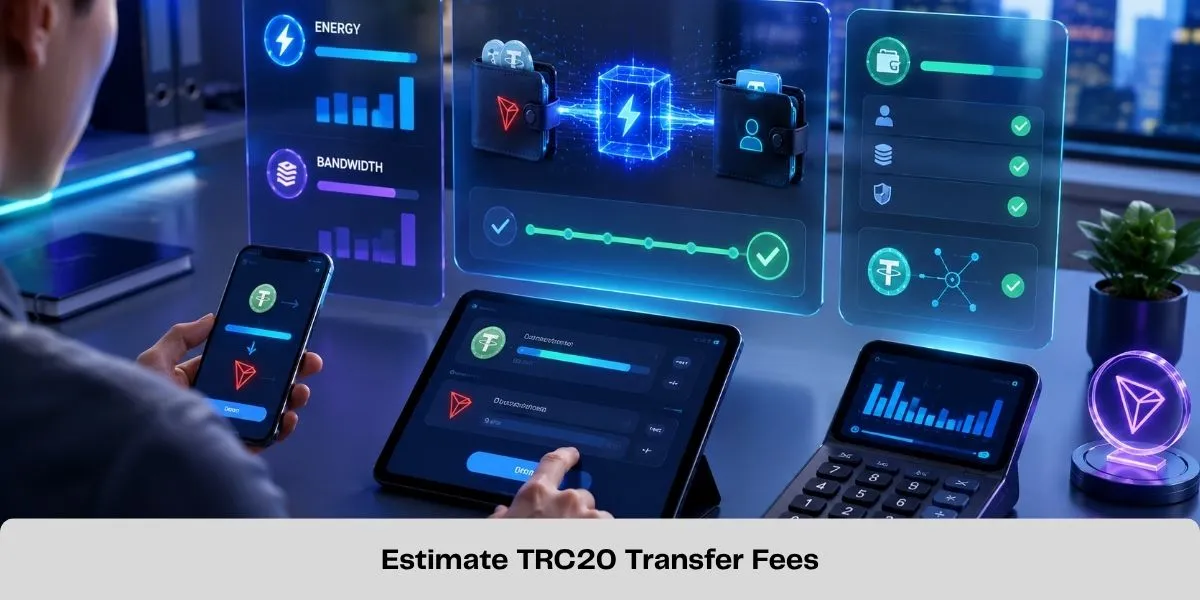
Use the TRON Energy Calculator before sending instead of relying on a fixed number copied from an old transaction.
Method 1: Stake TRX for Energy
Stake 2.0 allows you to stake TRX for Energy or Bandwidth. The amount of Energy assigned to your account depends on your share of the total TRX staked for Energy across the network, so a fixed amount of TRX does not permanently produce a fixed amount of Energy.
When staking makes sense
Staking is most suitable when you:
- send TRC20 tokens frequently;
- already plan to hold a substantial TRX balance;
- have predictable daily or weekly Energy usage;
- value a recurring resource allocation more than immediate liquidity.
Advantages
- Energy replenishes after it is consumed.
- You retain ownership of the staked TRX.
- Staking also generates TRON Power for voting.
- It can be economical for consistent, high-volume usage.
Limitations
- Capital remains tied up instead of being available for trading or operations.
- The amount of TRX required changes with network-wide staking conditions.
- After initiating an unstake under Stake 2.0, the current network parameter requires a 14-day waiting period before the TRX can be withdrawn.
- Overestimating your long-term needs can leave you with unused Energy capacity.
Staking is not "free Energy." The direct transaction payment may disappear, but the capital has an opportunity cost and cannot be withdrawn immediately after unstaking.
Method 2: Rent Delegated TRON Energy
TRON allows unused Energy obtained through Stake 2.0 to be delegated to another activated account. Energy marketplaces use this native delegation mechanism to connect resource providers with users who need Energy for a limited period.
Instead of staking a large amount of TRX yourself, you pay for the Energy needed for one transfer or a defined rental period. The delegated resource is sent to your public TRON address; the provider does not need your private key or control of your wallet.
When Energy rental makes sense
Renting is usually the more practical option when you:
- make occasional or variable USDT transfers;
- do not want to lock capital in TRX;
- need Energy immediately;
- want a known quote before sending;
- manage payments across several wallets.
Advantages
- No long-term TRX lock-up.
- Resource delivery can be completed before the USDT transaction is signed.
- You can select an amount based on the expected transaction requirement.
- The rental cost may be lower than burning TRX for the same Energy shortfall.
Limitations
- Savings are not a fixed percentage.
- Delegated Energy is normally available for a limited period.
- Renting too little Energy can still leave a shortfall.
- The receiving address must be eligible to receive delegated resources.
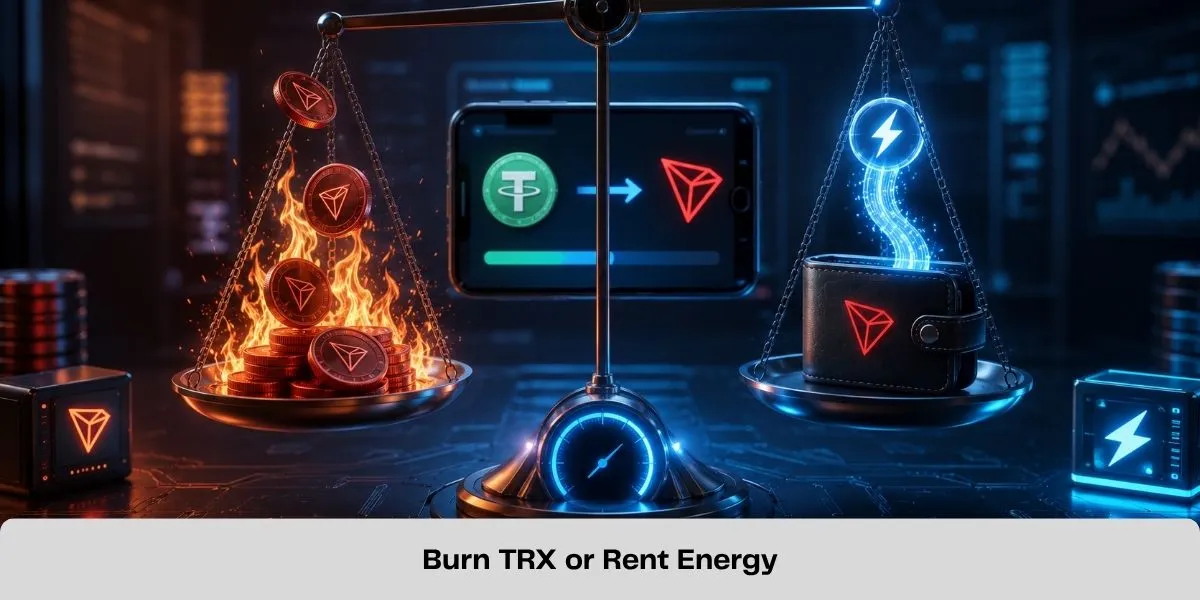
When the live rental quote is lower than the projected TRX burn, you can rent TRON Energy before sending. Compare the quote against the estimated resource requirement rather than choosing a package from an old rule of thumb.
For a direct economic comparison, read TRON Energy vs Burning TRX.
Method 3: Estimate Energy Before You Send
The third method does not create Energy. It reduces avoidable costs by making the transfer predictable before it is broadcast.
This matters because a failed smart-contract transaction can still consume Energy or burn TRX. Buying too little delegated Energy can also leave the wallet paying for the remaining shortfall, while buying far more than required can waste a short rental window.
Before every important transfer:
- Check whether the recipient already has a USDT balance.
- Confirm that the recipient address is valid and activated when required.
- Review the sending wallet's available Energy and Bandwidth.
- Estimate the current Energy requirement.
- Compare the projected TRX burn with the live Energy rental price.
- Keep enough TRX for the quoted payment and any small resource shortfall.
- Wait until delegated Energy is visible in the sending wallet before broadcasting the USDT transaction.
This method is particularly important for businesses and payment teams. A pre-transfer check can be built into an operating workflow so employees do not guess resource requirements or retry failed transactions repeatedly.
Which Method Is Best for You?
| User profile | Best starting method | Reason |
|---|---|---|
| One-time or occasional sender | Estimate, then rent if economical | Avoids long-term capital lock-up |
| Frequent individual sender | Compare staking with recurring rentals | The better option depends on volume and TRX holdings |
| Business or payment team | Estimate every transfer and use delegated Energy | Supports predictable cost control across wallets |
| Long-term TRX holder with steady usage | Stake TRX for Energy | Recurring Energy may justify the locked capital |
| Wallet with uncertain destination history | Estimate using the higher likely requirement | Reduces the risk of an Energy shortfall |
The right method depends on frequency, capital requirements and operational predictability. There is no single percentage saving that applies to every wallet.
Step-by-Step: Reduce TRC20 Fees Before Your Next Transfer
Step 1: Verify the network and recipient
Confirm that both sides support TRC20 USDT. A correct TRON address normally begins with T. Do not send ERC20 or another network version of USDT to a TRON address.
Step 2: Inspect the recipient's USDT state
Check the address on a block explorer. A recipient with no existing USDT balance can require substantially more Energy than one that already stores USDT.
Step 3: Check your wallet resources
Review the available Energy and Bandwidth in the sending wallet. Do not assume that holding TRX means the wallet already has Energy; unstaked TRX is generally burned to pay for missing resources.
Step 4: Estimate the current requirement
Use a current calculator or wallet estimate. Treat 64,000 and 130,000 Energy as reference magnitudes, not guaranteed package sizes.
Step 5: Compare the three payment paths
Compare:
- the estimated TRX burn;
- the value and liquidity cost of staking;
- the current delegated Energy quote.
Choose the option with the best total cost for your actual transfer frequency.
Step 6: Confirm Energy before sending
If you rent Energy, enter the public address of the wallet that will send the USDT. Confirm that the delegated Energy has arrived before signing the transfer.
Step 7: Send once and verify on-chain
Review the destination address, network and amount, then broadcast the transaction. Verify the transaction result on-chain before attempting another transfer.
Common Mistakes That Increase TRC20 Fees
Treating a fixed Energy number as permanent
USDT Energy consumption can change with the dynamic Energy model. Historical figures are useful references, not permanent guarantees.
Renting Energy for the wrong wallet
Delegated Energy must be assigned to the sending wallet that executes the USDT smart-contract transaction, not the recipient.
Sending before the Energy arrives
If the transaction is broadcast first, the network cannot apply Energy that arrives later. The wallet may burn TRX or the transaction may fail.
Assuming "no USDT balance" means the address is invalid
An activated TRON account can still have no USDT balance. The important distinction for Energy estimation is the token storage state, not a vague active-versus-inactive label.
Retrying a failed transaction without diagnosing it
A failed smart-contract call may still consume resources. Check the receipt, Energy usage, fee limit and wallet balance before retrying.
Believing a private key is required for delegation
Receiving delegated Energy only requires a public address. Never provide a private key, seed phrase or wallet recovery phrase to an Energy provider.
Frequently Asked Questions
What is the cheapest way to reduce TRC20 fees?
For occasional transfers, delegated Energy is often more capital-efficient than staking. For frequent and predictable usage, staking may become economical. Compare the current rental quote, expected TRX burn and opportunity cost of locked TRX before deciding.
Can I send TRC20 USDT without holding TRX?
A transfer can use available Energy and Bandwidth instead of burning TRX, but wallet and platform requirements vary. Keeping a small TRX balance provides a buffer for Bandwidth, rental payment or an unexpected resource shortfall.
How much Energy does a USDT transfer need?
Official TRON documentation currently describes approximate magnitudes of 64,000 Energy when the recipient already has a USDT balance and 130,000 Energy when it does not. Actual usage changes with the USDT contract's dynamic Energy factor and transaction conditions.
Does renting Energy make a TRON transaction faster?
Not necessarily. Energy changes how the resource cost is covered. It does not guarantee faster block confirmation.
Is delegated TRON Energy safe?
Resource delegation is a native Stake 2.0 function. A delegator can assign Energy to an activated external account without gaining control of its funds. Safety still depends on using a trustworthy service and never sharing private credentials.
Can a failed USDT transfer still charge a fee?
Yes. Smart-contract execution can consume resources before failure. That is why estimating Energy and checking the transaction receipt before retrying are essential.
Do TRC20 fees fall at night or during off-peak hours?
There is no dependable late-night discount. TRON's dynamic Energy model adjusts contract consumption according to contract resource usage across maintenance cycles. Do not delay an important transfer based on a time-of-day claim.
Reduce the Fee, Not the Reliability of the Transfer
Reducing TRC20 fees is not about finding a permanent loophole or assuming that one package fits every transaction. It is a resource-management decision.
Stake TRX when usage is steady enough to justify locked capital. Use delegated Energy when you need flexibility. Estimate the transaction before sending so the wallet has the right resources and you avoid preventable failures.
That workflow produces a more reliable result than relying on fixed fee claims, outdated Energy figures or an advertised saving percentage that may not match current network conditions.
Technical Sources for Fact Verification
Related Guides
How to Send USDT on TRON Without TRX for Network Fees
Learn how to send USDT on TRON without burning TRX for network fees by using TRON Energy. Check the required Energy and reduce TRC20 transfer costs.
Best TRON Wallets for TRX, USDT and Energy Management
Compare five TRON wallets for TRX, USDT and Energy management: TronLink, SafePal, imToken, Trust Wallet and Ledger with TronLink.
How Much Energy Does a USDT Transfer Require on TRON?
A TRON USDT transfer commonly needs about 65,000 or 131,000 Energy. Learn what determines the amount and how to estimate your shortfall.
How to Delegate TRON Energy with Stake 2.0
Learn how TRON Stake 2.0 resource delegation works, which resources can be delegated, wallet requirements, lock periods and how to undelegate safely.