
TRON vs Ethereum Fees: Why TRC20 USDT Transfers Cost Less
TRON vs Ethereum Fees: Why USDT Transfers Are Cheaper on TRON
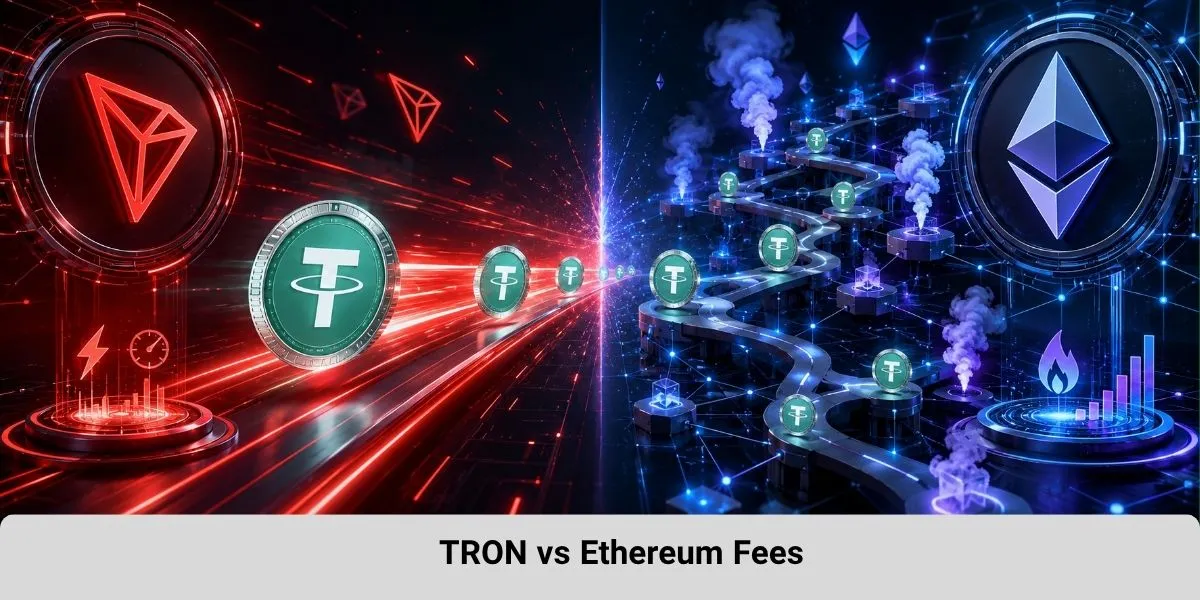
TRON fees are usually lower than Ethereum fees because the two networks price transactions in completely different ways. Ethereum uses a gas market, where users pay in ETH based on computational demand, base fee, priority fee, and network congestion. TRON uses a resource model built around Bandwidth and Energy. Simple TRX transfers consume Bandwidth, while TRC20 USDT transfers consume Energy.
If a user has enough staked or delegated Energy, they can avoid burning TRX directly for a USDT transfer. That does not mean the transaction is economically “free,” because Energy still has a cost: it either comes from staked TRX or from a temporary Energy rental. But in practice, this model often makes TRC20 USDT transfers cheaper and more predictable than ERC20 transfers on Ethereum Layer 1.
For everyday stablecoin payments, exchange withdrawals, freelancer payouts, and frequent USDT transfers, TRON is often the more cost-efficient network. Ethereum, on the other hand, remains stronger for deep DeFi liquidity, Ethereum-native applications, and users who prioritize decentralization over low fees.
Quick Comparison: TRON vs Ethereum Fees
| Factor | Ethereum / ERC20 | TRON / TRC20 |
|---|---|---|
| Fee model | Gas | Energy + Bandwidth |
| Fee token | ETH | TRX |
| Main cost driver | Gas demand, base fee, priority fee, and smart contract complexity | Energy consumption, available resources, TRX burn, or delegated Energy |
| USDT transfer cost | Often higher on Ethereum Layer 1 | Usually lower on TRON |
| Fee volatility | Can rise sharply during congestion | Usually more predictable, but still variable |
| Best use case | DeFi, large capital, Ethereum-native apps, Layer 2 ecosystem | Frequent USDT transfers, payments, remittances, exchange-to-wallet transfers |
| Cost reduction path | Use Ethereum Layer 2s or wait for lower gas | Stake TRX or rent/delegate Energy |
| Main trade-off | Higher cost, stronger decentralization | Lower cost, more concentrated block production |
Why Are TRON Fees Lower Than Ethereum Fees?
The short answer is: TRON was designed for high-throughput, low-cost transactions, while Ethereum was designed as a highly decentralized smart contract platform.
Ethereum and TRON both support tokens, smart contracts, decentralized applications, and stablecoins like USDT. But they use different systems to process transactions and charge users.
Ethereum charges gas for every operation. When the network is busy, users compete for limited block space by paying higher fees. This is why ERC20 USDT transfers can become expensive during periods of high demand.
TRON uses a resource system. Instead of paying a normal gas fee for every action, users consume Bandwidth and Energy. Bandwidth is used for basic transaction data, while Energy is used for smart contract execution, including TRC20 USDT transfers. Users can get Energy by staking TRX or receiving delegated Energy from another account.
This is the key reason TRON can be cheaper: users do not always need to burn TRX directly. They can use Energy instead.
Ethereum Gas Explained: Why ERC20 USDT Transfers Can Be Expensive
On Ethereum, every transaction requires gas. Gas measures the computational effort needed to execute a transaction or smart contract operation.
A simple ETH transfer requires less gas than a token transfer. Sending ERC20 USDT is not just a basic ETH transfer; it interacts with the USDT smart contract. That means the Ethereum Virtual Machine has to execute contract logic, update balances, and record the transaction on-chain. This requires more computation and therefore more gas.
Ethereum fees are generally calculated using this idea:
Gas used × (base fee + priority fee)
The base fee is set by the protocol and changes depending on network demand. The priority fee is an optional tip that helps incentivize validators to include the transaction faster.
When Ethereum is quiet, fees can be low. But when demand increases — for example during NFT launches, DeFi liquidations, token launches, market volatility, or meme coin trading — users compete for block space. This can push fees higher.
That is why an ERC20 USDT transfer can feel unpredictable. The amount of USDT you send does not matter as much as the network conditions and contract execution cost. Sending $50 and sending $5,000 of ERC20 USDT can require a similar type of contract interaction, but the fee depends on Ethereum gas conditions at that moment.
TRON Energy and Bandwidth Explained
TRON uses a different model. Instead of relying only on a gas bidding system, the network separates resources into Bandwidth and Energy.
Bandwidth
Bandwidth is used to store and transmit transaction data on the TRON network. Basic transactions, such as transferring TRX, consume Bandwidth.
Every external TRON account receives a small amount of free Bandwidth daily. Users can also stake TRX to receive more Bandwidth. If there is not enough Bandwidth available, TRX may be burned to pay for the missing resource.
For most users, Bandwidth is not the main cost problem. The bigger issue appears when they transfer TRC20 tokens like USDT.
Energy
Energy is used when a smart contract is executed on TRON. Since USDT on TRON is a TRC20 token, transferring it requires interaction with the USDT smart contract. That means it consumes Energy.
If your wallet has enough Energy, the transaction can be processed without directly burning TRX for Energy. If your wallet does not have enough Energy, TRX will be burned to cover the required Energy. If you do not have enough TRX to cover the burn, the transaction can fail.
This is why many TRON users are surprised when they try to send USDT and see that they need TRX. They are not paying “gas” in the Ethereum sense, but they still need resources to execute the TRC20 smart contract.
ERC20 vs TRC20 USDT Fees: What Users Actually Pay
For most users, the real question is simple:
Should I send USDT using ERC20 or TRC20?
In many everyday cases, TRC20 is cheaper. This is why TRON has become one of the most popular networks for USDT transfers, especially among users who send stablecoins frequently.
ERC20 USDT is widely supported and deeply integrated into the Ethereum ecosystem, but it can be expensive on Ethereum Layer 1 when gas demand is high. TRC20 USDT is often preferred for practical transfers because the fee is usually lower and the transaction experience is faster.
However, fees are not fixed forever. They can vary depending on:
- Network activity
- Smart contract Energy consumption
- TRX and ETH prices
- Wallet settings
- Whether the receiving TRON account is already activated
- Whether the sender has enough Energy or must burn TRX
- Whether the Ethereum transaction is on Layer 1 or Layer 2
So the better way to compare ERC20 and TRC20 is not to ask “Which one is always cheaper?” The better question is:
Which network is cheaper for this specific transfer, at this specific moment, with this specific wallet setup?
For frequent USDT transfers, TRON usually wins on cost. For Ethereum-native DeFi activity, Ethereum or an Ethereum Layer 2 may still be the better choice.
Why TRON Is Faster for Everyday Transfers
TRON and Ethereum also differ in how they reach consensus and produce blocks.
Ethereum uses Proof of Stake. It has a broad validator ecosystem and is built around decentralization, security, and neutrality. This makes Ethereum highly trusted for large-scale DeFi, institutional capital, and complex smart contract applications.
TRON uses Delegated Proof of Stake. In this model, block production is handled by a smaller group of Super Representatives elected by TRX holders. This structure allows TRON to process transactions quickly and keep costs lower, but it also means block production is more concentrated than Ethereum’s validator system.
That is the main trade-off:
- Ethereum prioritizes decentralization and deep security.
- TRON prioritizes speed, low cost, and practical transfer efficiency.
For someone managing millions of dollars in Ethereum-native DeFi positions, Ethereum may be worth the higher cost. For someone sending USDT several times a week, paying high ERC20 fees may not make sense.
What About Ethereum Layer 2s?
A fair comparison should not ignore Ethereum Layer 2 networks.
Ethereum Layer 2s, such as Arbitrum, Optimism, Base, and other rollup-based networks, are designed to reduce costs and improve scalability. In many cases, sending assets on a Layer 2 can be much cheaper than using Ethereum Layer 1.
This is important because the old comparison of “Ethereum is always expensive and TRON is always cheap” is too simple.
A better comparison is:
- Ethereum Layer 1 is often expensive for small, frequent transfers.
- Ethereum Layer 2s can reduce costs significantly.
- TRON remains one of the most convenient and widely used networks for simple USDT transfers, especially where TRC20 is already supported by exchanges, wallets, and payment workflows.
For users who already live inside the Ethereum ecosystem, Layer 2s may be a good option. But for users who simply want to send USDT from one wallet or exchange to another with lower fees, TRC20 remains one of the most practical choices.
Account Activation Fee on TRON: A Small Detail Many Users Miss
There is one important TRON fee that many beginner guides ignore: account activation.
A new TRON address does not fully exist on-chain until it is activated. Activation can happen when the account receives TRX or certain tokens from an existing account, or through account creation methods supported by the network. This process may involve a small account creation cost and resource usage.
For most users, this is a one-time detail. But it matters when sending USDT to a brand-new TRON address.
If the receiving address has never been activated, the transaction may require extra resources. This is one reason why two USDT transfers on TRON may not always cost exactly the same.
Before sending funds to a new address, it is always better to check whether the wallet is active and whether you have enough TRX or Energy to complete the transaction safely.
How to Reduce TRON USDT Transfer Costs
There are three common ways to handle the cost of TRC20 USDT transfers.
1. Burn TRX Directly
This is the simplest method. You keep TRX in your wallet, send USDT, and let the network burn TRX if your account does not have enough Energy.
This works, but it is often the most expensive option for frequent users.
If you only send USDT once in a while, burning TRX may be acceptable. But if you send USDT often — for payments, payouts, trading, or business operations — direct TRX burn can become inefficient.
2. Stake TRX for Energy
The second option is staking TRX to receive Energy. When you stake TRX for Energy, your wallet receives network resources that can be used for smart contract transactions.
This can be a good solution for long-term users who hold enough TRX and send TRC20 transactions regularly.
The trade-off is capital lockup. You need to hold and stake TRX to generate Energy. If your transaction volume changes, you may generate too much or too little Energy for your actual needs.
3. Rent or Receive Delegated Energy
The third option is Energy rental or delegated Energy.
Instead of staking a large amount of TRX yourself, you can temporarily receive Energy from another account that already has staked resources. This is where platforms like TronMax become useful.
With TronMax, users can rent the required TRON Energy before making a USDT transfer. The goal is not to make blockchain usage magically free. The goal is to avoid expensive direct TRX burns and reduce the effective cost of TRC20 transfers.
For businesses, traders, payment operators, and frequent USDT users, this can be much more efficient than holding large amounts of TRX only for transaction fees.
How TronMax Helps Reduce TRC20 Fees
TronMax is built for users who want to reduce TRON transaction costs without manually managing complex staking resources.
When you rent Energy through TronMax, delegated Energy is sent to your wallet for a limited period. You can then use that Energy to complete your TRC20 USDT transfer while avoiding direct TRX burn for the Energy portion of the transaction.
This is especially useful for:
- Frequent USDT transfers
- Crypto traders
- Payment teams
- Freelancers receiving or sending stablecoins
- Businesses that process many TRC20 payouts
- Users who do not want to lock capital in TRX staking
The practical benefit is simple: instead of paying the full TRX burn cost every time, you can use rented Energy to lower the effective transaction cost.
Before sending, users should always make sure they rent enough Energy for the type of transaction they want to perform. TRC20 USDT transfers consume Energy, and the required amount can vary depending on the contract state and network resource conditions.
If you are unsure how much Energy you need, use the TronMax Energy Calculator or check our guide on how much Energy a USDT transfer requires.
When Should You Use TRON Instead of Ethereum?
TRON is usually a better choice when your main goal is to send USDT quickly and cheaply.
You may prefer TRON when:
- You send USDT frequently.
- You are making small or medium-sized payments.
- You are paying freelancers or contractors.
- You are moving funds between exchanges and wallets.
- You want lower and more predictable transfer costs.
- You want to reduce direct TRX burns by using Energy rental.
- Your recipient supports TRC20 USDT.
For these use cases, Ethereum Layer 1 may be unnecessarily expensive. TRON is often more practical because the transfer cost is lower relative to the amount being sent.
When Ethereum May Still Be the Better Choice
Lower fees do not automatically make TRON better for every situation.
Ethereum may still be the better choice when:
- You are using Ethereum-native DeFi protocols.
- You need access to deep liquidity on Ethereum.
- You are managing large positions where decentralization is more important than fee savings.
- Your assets are already on Ethereum.
- You want to use Ethereum Layer 2 ecosystems.
- Your counterparty specifically requires ERC20 USDT.
Ethereum has the largest smart contract ecosystem, a massive developer community, and deep integration across DeFi. For complex DeFi activity, Ethereum can still be worth the higher cost.
The real decision is not “TRON is better” or “Ethereum is better.”
The better decision is:
Use TRON when your priority is low-cost USDT transfers. Use Ethereum or Ethereum Layer 2s when your priority is Ethereum-native DeFi, liquidity, and decentralization.
Final Verdict: TRON for Payments, Ethereum for DeFi Depth
TRON and Ethereum solve different problems.
Ethereum is a general-purpose smart contract platform with strong decentralization, deep liquidity, and a large DeFi ecosystem. Its gas model is powerful, but Ethereum Layer 1 can be expensive when demand is high.
TRON is optimized for fast and low-cost transfers. Its Energy and Bandwidth model makes it especially useful for TRC20 USDT transactions. Users who stake or rent Energy can reduce direct TRX burns and make frequent transfers more cost-efficient.
For everyday USDT payments, TRON is often the more practical network. For Ethereum-native DeFi and large-scale smart contract activity, Ethereum remains one of the strongest ecosystems in crypto.
If your goal is to send USDT with lower fees, TRC20 is usually the better option. And if you want to reduce your TRON transfer cost even further, renting Energy through TronMax can help you avoid unnecessary TRX burns and make your transfers more efficient.
FAQ
Is TRON cheaper than Ethereum for USDT transfers?
In many cases, yes. TRC20 USDT transfers on TRON are usually cheaper than ERC20 USDT transfers on Ethereum Layer 1. However, actual costs can vary depending on network conditions, Energy availability, TRX price, ETH gas fees, and whether the transaction is happening on Ethereum Layer 1 or a Layer 2 network.
Why is TRC20 USDT cheaper than ERC20 USDT?
TRC20 USDT is usually cheaper because TRON uses Energy and Bandwidth instead of Ethereum’s gas market. If a TRON wallet has enough Energy, it can avoid burning TRX directly for the smart contract execution. Ethereum ERC20 transfers require gas paid in ETH, and gas prices can increase when the network is congested.
Does TRON have gas fees?
TRON does not use gas in the same way Ethereum does. Instead, it uses Bandwidth and Energy. Basic transactions consume Bandwidth, while smart contract transactions such as TRC20 USDT transfers consume Energy. If the user does not have enough resources, TRX may be burned to cover the cost.
What is the difference between Ethereum gas and TRON Energy?
Ethereum gas measures the computational work needed to execute transactions and smart contracts on Ethereum. Users pay gas fees in ETH. TRON Energy measures the computational resources needed to execute smart contracts on TRON. Users can get Energy by staking TRX or receiving delegated Energy from another account.
Can I send USDT on TRON without burning TRX?
Yes, if your wallet has enough Energy for the TRC20 USDT transfer, you can avoid burning TRX directly for the Energy cost. You can get Energy by staking TRX or renting delegated Energy from a platform like TronMax. However, this does not mean the transaction is economically free, because Energy itself has value.
Why does a TRON USDT transfer sometimes cost more than expected?
A TRON USDT transfer can cost more than expected if your wallet does not have enough Energy, if the receiving account is not activated, if the smart contract consumes more Energy due to network conditions, or if the transaction requires additional resources. This is why it is important to check Energy requirements before sending.
What is the TRON account activation fee?
A new TRON address must be activated before it fully exists on-chain. Activation can require a small account creation cost and additional resources. This mainly matters when sending funds to a brand-new TRON wallet address.
Are Ethereum Layer 2s cheaper than TRON?
Ethereum Layer 2s can be much cheaper than Ethereum Layer 1 and may compete with TRON for low-cost transfers. However, the best option depends on exchange support, wallet support, liquidity, the token network your recipient accepts, and whether you are already using the Ethereum ecosystem.
Is TRON less decentralized than Ethereum?
TRON uses Delegated Proof of Stake with Super Representatives, while Ethereum uses a broader Proof of Stake validator system. TRON’s model helps it achieve faster and cheaper transactions, but Ethereum is generally considered stronger in decentralization. This is one of the main trade-offs between the two networks.
Should I use ERC20 or TRC20 for USDT transfers?
Use TRC20 if your priority is low-cost, frequent USDT transfers and your recipient supports the TRON network. Use ERC20 if you need Ethereum-native DeFi access, deeper Ethereum liquidity, or your recipient specifically requires Ethereum-based USDT. For lower Ethereum costs, you can also consider supported Layer 2 networks.
Related Guides
How to Send USDT on TRON Without TRX for Network Fees
Learn how to send USDT on TRON without burning TRX for network fees by using TRON Energy. Check the required Energy and reduce TRC20 transfer costs.
Best TRON Wallets for TRX, USDT and Energy Management
Compare five TRON wallets for TRX, USDT and Energy management: TronLink, SafePal, imToken, Trust Wallet and Ledger with TronLink.
How Much Energy Does a USDT Transfer Require on TRON?
A TRON USDT transfer commonly needs about 65,000 or 131,000 Energy. Learn what determines the amount and how to estimate your shortfall.
How to Delegate TRON Energy with Stake 2.0
Learn how TRON Stake 2.0 resource delegation works, which resources can be delegated, wallet requirements, lock periods and how to undelegate safely.