
Can You Earn 30% to 39% APY by Selling TRON Energy?
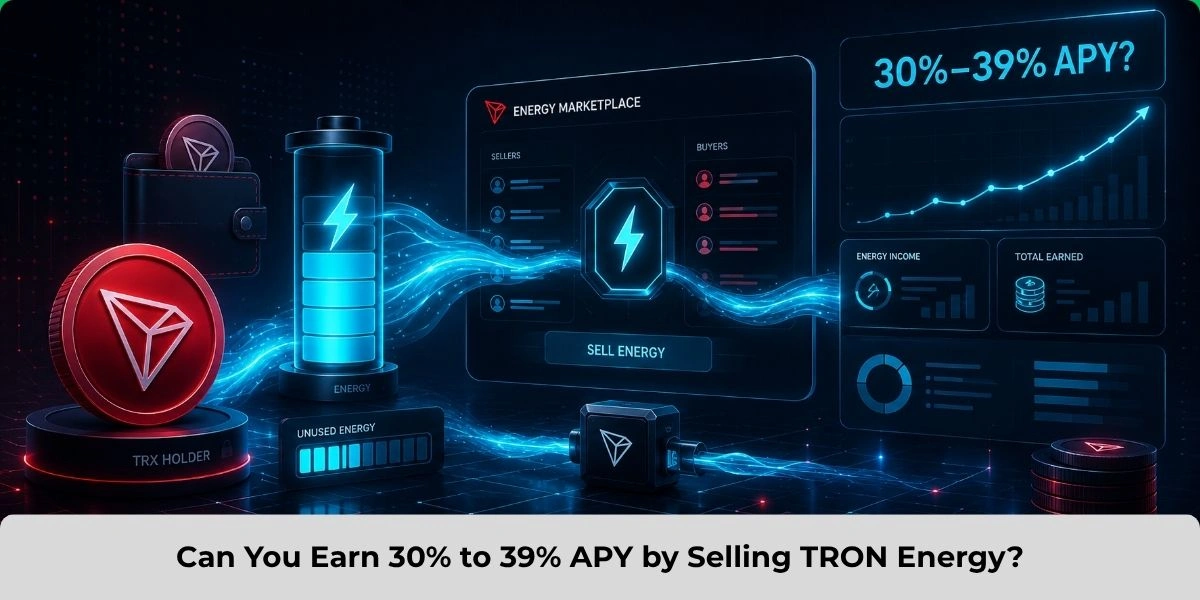
Many TRX holders think staking is only about earning a modest network yield or voting for Super Representatives. But on TRON, staking can also create a practical resource: Energy. Because TRC20 transfers and smart contract transactions consume Energy, users who do not want to burn TRX often prefer to rent delegated Energy instead. That demand creates an opportunity for long-term TRX holders to sell TRON Energy through TronMax and turn unused network resources into a yield opportunity.
The often-mentioned 30% to 39% APY range is not a guaranteed return. It depends on market demand, Energy utilization, TRX price, platform conditions, rental duration, and how consistently your generated Energy is used by buyers. Still, for users who already hold TRX and understand the lock-up rules of staking, selling Energy can be a more active way to monetize idle resources than simply leaving TRX unused in a wallet.
This guide explains how the model works, where the yield can come from, what affects your actual return, and how to think about selling TRON Energy safely and realistically.
Risk note: This article is educational and is not financial advice. Crypto yields are variable, and APY can change based on network demand, TRX price, platform liquidity, and market conditions. Do your own research before staking or allocating capital.
Why TRON Energy Has Market Demand
TRON uses a resource model instead of a simple Ethereum-style gas market. Bandwidth is used for transaction data, while Energy is used for smart contract computation. That distinction matters because TRC20 tokens such as USDT interact with smart contracts, and those transfers usually require Energy. For a deeper explanation of the resource model, read the guide on TRON Energy and Bandwidth.
When a wallet does not have enough Energy, the TRON network may burn TRX to cover the missing resource. For frequent USDT users, traders, exchanges, payment operators, and businesses, repeatedly burning TRX can become inefficient. Renting delegated Energy can reduce that cost, which is why there is real demand from buyers.
This demand is the foundation of the seller-side opportunity. If you stake TRX for Energy and do not need all of that Energy yourself, your unused Energy can potentially be delegated to users who need it for TRC20 transactions.
How Staking TRX Creates Energy You Can Sell
TRX can be staked to obtain network resources. Under TRON Stake 2.0, users can choose whether they want to obtain Energy or Bandwidth from their staked TRX. For sellers, Energy is usually the more relevant resource because TRC20 transfers and many contract interactions require it.
The important point is that Energy comes from staked TRX. You are not minting a new token, and you are not depositing into a high-risk liquidity pool. You are using the resource system built into TRON: stake TRX, generate Energy, then make unused Energy available for delegation through a marketplace.
If you want the technical background first, review the guide on Stake 2.0 resource delegation before using a seller dashboard.
| Component | What it means for sellers |
|---|---|
| Staked TRX | Your locked TRX generates network resources such as Energy. |
| Generated Energy | The resource buyers need for TRC20 transfers and smart contract transactions. |
| Delegation | The process of making your Energy available to another wallet without transferring your TRX ownership. |
| Rental payment | The buyer pays for temporary access to delegated Energy. |
| Actual yield | Depends on demand, utilization, pricing, TRX value, and platform conditions. |
Remember that staking has a liquidity cost. If you unstake, TRX is not instantly available for withdrawal; TRON Stake 2.0 includes a lock-up period after unstaking. This should be part of your capital planning before you decide how much TRX to stake.
How Selling TRON Energy Works on TronMax
TronMax simplifies the seller-side workflow by connecting Energy providers with users who need cheaper TRC20 transfers. Instead of negotiating manually with buyers, a marketplace can help match available Energy with demand and handle delegation logic through the platform flow.
If you want to understand the infrastructure layer behind this model, read the guide on how TRON Energy pools work. In simple terms, sellers provide unused Energy generated from staked TRX, and buyers use delegated Energy to complete TRC20 transfers with lower effective cost than direct TRX burning.
Step 1: Hold TRX in a Wallet That Supports TRON Resources
Start with TRX in a wallet that supports TRON staking and resource management. TronLink is commonly used in the TRON ecosystem, but the key requirement is that your wallet lets you stake TRX, manage Energy, and interact safely with TRON applications.
Step 2: Stake TRX for Energy
Stake your TRX and choose Energy as the resource target. This matters because Bandwidth is useful for simple transaction data, but Energy is the resource most buyers need for TRC20 USDT transfers and other smart contract interactions.
Do not stake more TRX than you are comfortable locking. Your potential yield may be attractive, but the capital is not instantly liquid after you decide to unstake.
Step 3: Connect to the TronMax Seller Dashboard
After staking, connect your wallet to the TronMax seller-side flow. The platform should be able to detect available resources and show how much Energy may be available for selling or delegation.
Only connect through the official TronMax domain. Never share your seed phrase or private key with any platform. A legitimate resource delegation workflow should not require your recovery phrase.
Step 4: Make Your Unused Energy Available
Once your Energy is available, it can be matched with users who want to reduce TRC20 transfer costs. The buyer does not receive your TRX. Instead, the resource is delegated for use according to the platform rules and the rental window.
This is why the model can be useful for long-term holders. You keep exposure to TRX while attempting to monetize the Energy generated by staking.
Step 5: Track Utilization and Payouts
Your realized return depends on utilization. If your Energy is consistently rented, the effective yield can be higher. If demand slows or your resources sit unused, actual APY can be lower. Track your payouts, utilization rate, and the amount of TRX kept staked so you can judge whether the strategy still makes sense.
Where the 30% to 39% APY Range Comes From
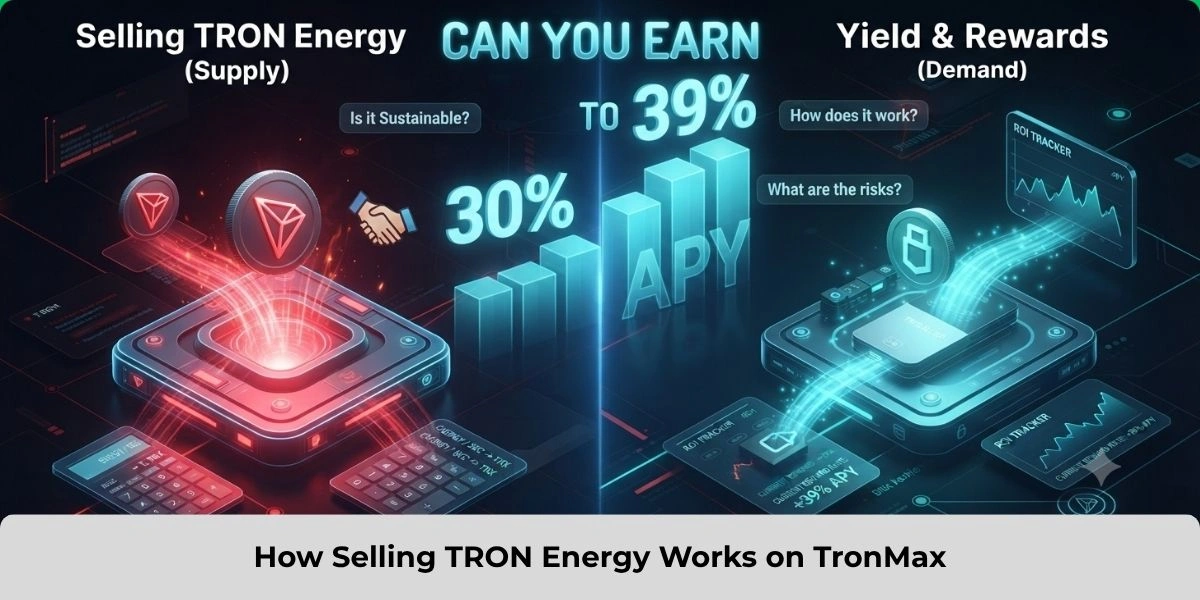
The 30% to 39% APY range is best understood as a potential market-based outcome, not a fixed network reward. Standard staking yield and Energy-selling yield are not the same thing. Standard staking rewards are related to network participation and voting economics. Energy-selling yield comes from buyers paying to use delegated Energy because it can help them avoid larger TRX burns on TRC20 transfers.
In practice, the APY depends on how much Energy your staked TRX generates, how much of that Energy is rented by buyers, the price buyers pay, how frequently the Energy becomes available again, and how TRX price moves over time.
| Factor | Impact on APY |
|---|---|
| Energy demand | Higher buyer demand can increase utilization and potential seller revenue. |
| Utilization rate | Unused Energy reduces realized yield. |
| Rental pricing | Lower marketplace prices can reduce seller APY; higher prices can increase it if demand remains strong. |
| TRX price | APY calculations can change as TRX price changes. |
| Network rules | Changes in TRON resource economics can affect Energy generation and demand. |
| Platform conditions | Fees, matching speed, and buyer liquidity can affect final returns. |
For that reason, it is better to describe 30% to 39% APY as a possible range seen under certain conditions, not as a guaranteed promise.
What Can Reduce Your Actual Yield?
The seller-side model is attractive, but it is not automatic profit. Several things can reduce your actual return.
- Lower demand: If fewer users need Energy, your resources may not be rented as often.
- Lower utilization: Energy that sits unused does not produce rental income.
- Price changes: TRX price movement can affect the value of payouts and APY calculations.
- Network changes: TRON resource rules, Energy consumption, or contract behavior may change over time.
- Lock-up period: Staked TRX is not fully liquid, and unstaking requires planning.
- Operational mistakes: Connecting to the wrong site, signing unsafe permissions, or misunderstanding staking rules can create avoidable risk.
Staking TRX vs Selling TRON Energy
Basic staking and selling Energy are related, but they are not identical strategies. If you only stake TRX and vote, your return depends on staking and voting economics. If you stake TRX for Energy and sell that Energy, you are adding a marketplace-based resource revenue layer.
| Strategy | Best for | Main trade-off |
|---|---|---|
| Basic TRX staking | Users who want simple network participation and voting rights. | Usually simpler, but may not fully monetize unused Energy. |
| Staking TRX for Energy | Users who need Energy for their own TRC20 activity. | Reduces personal TRX burns but may leave unused resources. |
| Selling TRON Energy | Long-term TRX holders who want to monetize unused generated Energy. | Potentially higher yield, but depends on buyer demand and resource utilization. |
For a broader beginner-friendly view of staking, see the guide on staking TRX in 2026.
Who Is This Strategy Best For?
Selling Energy is not for every crypto user. It makes the most sense when you already hold TRX long term and understand that staking reduces short-term liquidity.
- Long-term TRX holders who do not need immediate liquidity.
- Users who understand TRON resources and are comfortable with wallet permissions.
- Sellers who want to monetize generated Energy instead of letting it sit unused.
- Operators who can monitor payouts, utilization, and platform conditions.
- Users who understand that APY can change and is not guaranteed.
It may not be suitable for users who need instant access to their TRX, do not understand wallet signing, or are uncomfortable with market-based yield fluctuation.
**Safety Checklist Before Listing Your Energy
**Before connecting a wallet or staking TRX, use a basic safety checklist.
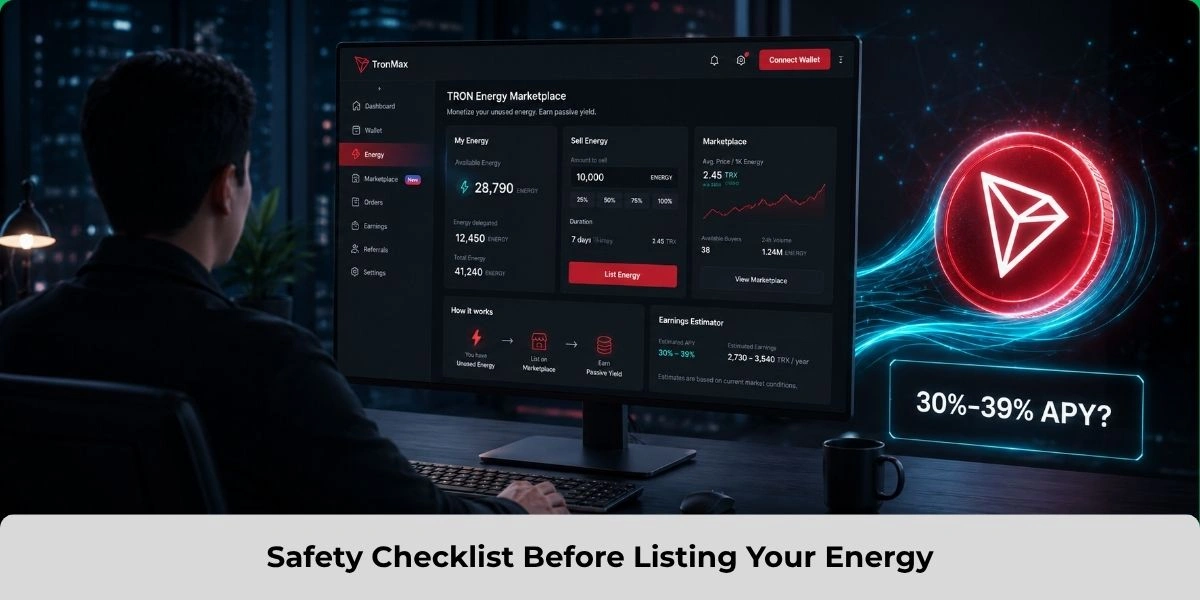
- Use only the official TronMax website and verify the domain carefully.
- Never share your seed phrase, private key, or recovery phrase.
- Understand the staking and unstaking timeline before locking TRX.
- Review wallet permissions before signing any transaction.
- Start with an amount you are comfortable testing before allocating more TRX.
- Track real payout data instead of assuming the highest advertised APY will apply to your wallet.
- Keep enough TRX available for normal wallet operations and resource management.
Final Takeaway
Selling TRON Energy can be a practical way for long-term TRX holders to monetize unused network resources. The opportunity exists because TRC20 users need Energy to avoid unnecessary TRX burns, and many prefer temporary delegated Energy over staking a large amount of TRX themselves.
The key is to treat APY realistically. A 30% to 39% range may be possible under strong demand and high utilization, but it should not be viewed as guaranteed. Your actual result depends on Energy demand, pricing, TRX price, platform conditions, network rules, and how consistently your resources are rented.
If you already hold TRX, understand the lock-up period, and want to put generated Energy to work, selling Energy through TronMax can turn idle resources into a more active yield strategy.
FAQ
Can I really earn 30% to 39% APY by selling TRON Energy?
That range should be treated as a possible market-based range, not a guaranteed return. Actual APY depends on buyer demand, utilization, TRX price, pricing, platform conditions, and network rules.
Is selling TRON Energy the same as staking TRX?
No. Staking TRX creates resources such as Energy or Bandwidth. Selling Energy means making unused generated Energy available to buyers who need it for TRC20 transfers or contract activity.
Do I lose ownership of my TRX when I sell Energy?
No. Selling Energy does not mean sending your TRX to the buyer. The buyer uses delegated resources, while your staked TRX remains associated with your wallet. You should still understand wallet permissions and platform rules before signing transactions.
What happens if nobody rents my Energy?
If demand is low or your Energy is not utilized, your realized yield can be lower. APY depends heavily on utilization.
How long is TRX locked when I stake?
Under TRON Stake 2.0, unstaked TRX is subject to a lock-up period before it can be withdrawn. Sellers should plan liquidity before staking.
Is this risk-free passive income?
No. It may be lower risk than some DeFi strategies, but it is not risk-free. Risks include market demand changes, TRX price movement, wallet permission mistakes, network changes, and platform conditions.
Who should consider selling TRON Energy?
Long-term TRX holders who understand staking, do not need instant liquidity, and want to monetize unused generated Energy may consider it. Beginners should start carefully and learn the resource model first.
Reference Notes for Technical Accuracy
The rewrite uses the following technical assumptions from official or TRON documentation sources:
Related Guides
How to Send USDT on TRON Without TRX for Network Fees
Learn how to send USDT on TRON without burning TRX for network fees by using TRON Energy. Check the required Energy and reduce TRC20 transfer costs.
Best TRON Wallets for TRX, USDT and Energy Management
Compare five TRON wallets for TRX, USDT and Energy management: TronLink, SafePal, imToken, Trust Wallet and Ledger with TronLink.
How Much Energy Does a USDT Transfer Require on TRON?
A TRON USDT transfer commonly needs about 65,000 or 131,000 Energy. Learn what determines the amount and how to estimate your shortfall.
How to Delegate TRON Energy with Stake 2.0
Learn how TRON Stake 2.0 resource delegation works, which resources can be delegated, wallet requirements, lock periods and how to undelegate safely.