
How to Choose the Best TRON Energy Marketplace in 2026
The best TRON Energy marketplace is not simply the platform displaying the lowest price. It should show what you are buying, how long the delegated Energy will remain available, which wallet receives it, how delivery can be verified and what happens if the order is not completed.
This matters because TRC20 USDT transfers consume Energy. If the sending wallet does not have enough, TRX can be burned to cover the resource shortfall or the transaction can fail when the available balance cannot cover execution.
A reliable marketplace gives users an alternative to staking a large amount of TRX themselves. But marketplaces differ in pricing, availability, delivery method, rental duration, support and security practices.
This guide explains how to compare providers using evidence that can be checked before and after payment-not vague promises about being the cheapest or fastest service.
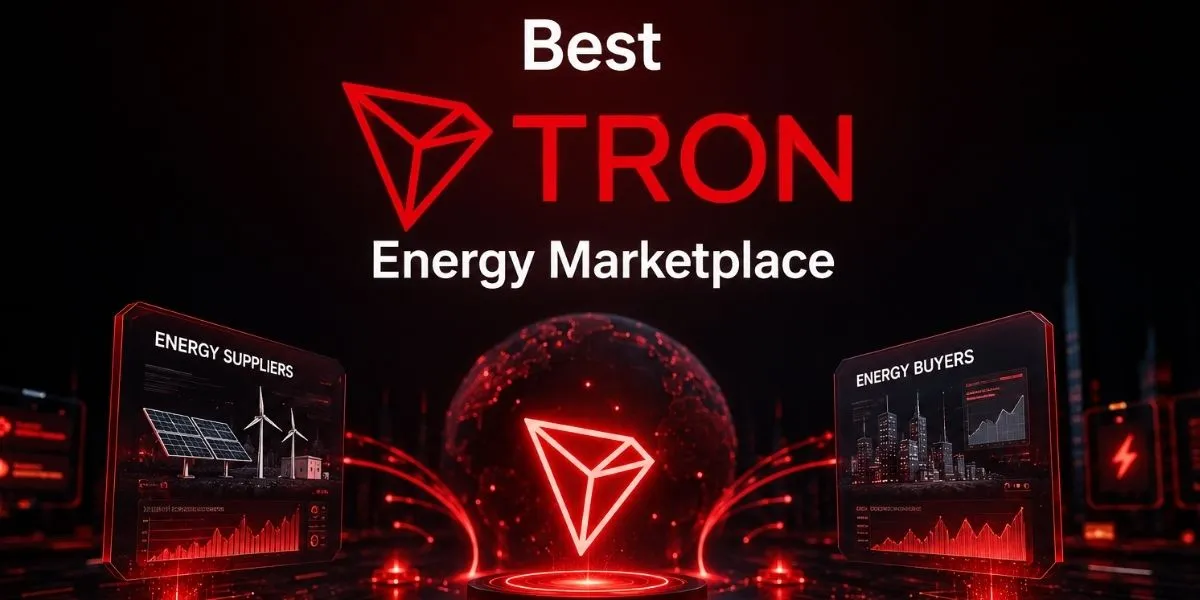
What Is a TRON Energy Marketplace?
A TRON Energy marketplace connects two sides of the resource economy:
- Resource providers stake TRX and receive Energy or Bandwidth.
- Resource users need those resources for USDT transfers, smart-contract calls, trading systems, payment operations or dApps.
TRON Stake 2.0 allows unused Energy obtained through staking to be delegated to another activated external account. A marketplace coordinates the order, payment and resource delegation between the provider and the user.
The user does not buy ownership of the provider's TRX. The user receives temporary access to delegated Energy under the conditions offered by the marketplace.
For a complete introduction to the mechanism, read What Is TRON Energy Rental?.
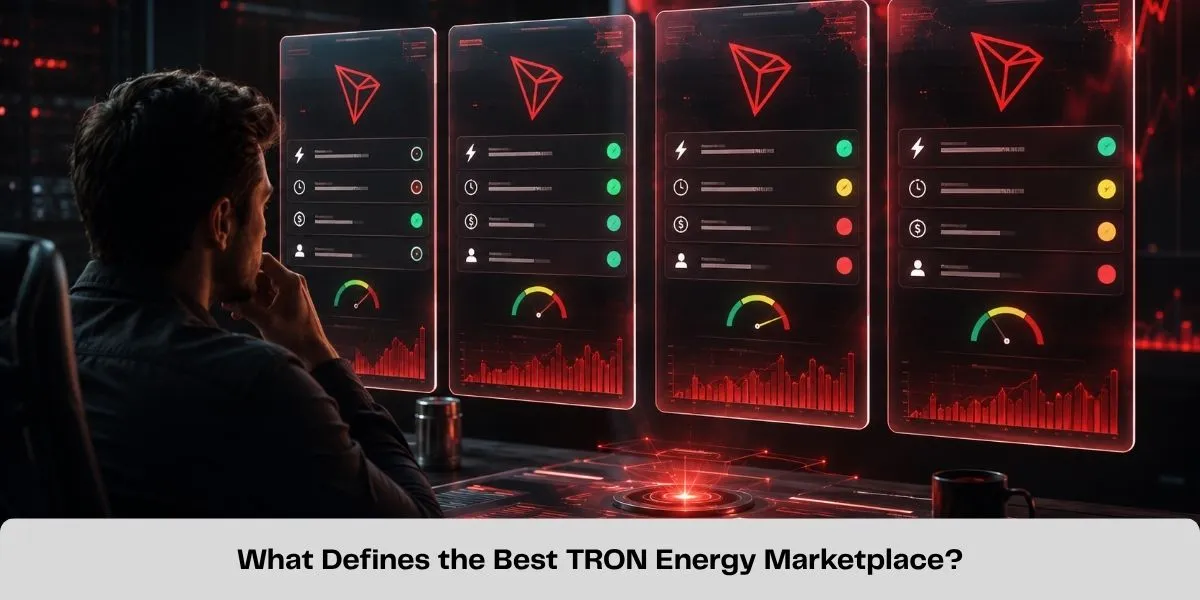
Quick Checklist: What Defines the Best TRON Energy Marketplace?
Use this checklist before choosing a provider:
| Evaluation factor | What a reliable marketplace should show |
|---|---|
| Energy amount | The resource quantity included in the order |
| Rental duration | How long the delegated Energy remains available |
| Total price | The complete quote before payment |
| Destination | The public TRON address that will receive Energy |
| Availability | Whether the requested amount can currently be delivered |
| Delivery confirmation | A wallet resource update or verifiable on-chain record |
| Security requirements | No request for a private key, seed phrase or wallet password |
| Failure handling | Clear support, retry or refund procedure |
| Service status | A visible way to check whether ordering systems are operational |
A marketplace that hides several of these details forces the buyer to make assumptions. In crypto transactions, assumptions are an unnecessary operational risk.
1. Transparent Pricing Before Payment
A useful quote should show the exact Energy amount, duration and total cost before the user transfers TRX or approves an order.
Do not compare providers using a headline such as "cheap Energy" alone. Compare equivalent orders:
- same Energy amount;
- same rental duration;
- same destination conditions;
- same payment method;
- same delivery guarantee;
- same refund or failure policy.
One provider may look cheaper because its order lasts for a shorter period or includes less Energy. Another may quote a higher amount but offer clearer fulfillment and support terms.
The price should also be compared with the expected TRX burn. If the marketplace quote is not lower than the resource shortfall the wallet would otherwise pay, the order may not provide an economic advantage.
2. Verifiable Energy Delivery
Energy delivery should be verifiable independently of the provider's success message.
After an order is completed, check the sending wallet's available Energy before broadcasting the USDT transaction. Depending on the wallet and explorer interface, users may also be able to inspect resource delegation or account resource changes on-chain.
A dashboard saying "completed" is not enough if the wallet still lacks the required resource.
The correct sequence is:
- Place the Energy order for the sending wallet.
- Wait for delivery confirmation.
- Verify the Energy in the wallet or on-chain account data.
- Send the TRC20 transaction.
If USDT is sent before Energy arrives, the network cannot apply resources delivered afterward to that earlier transaction.
3. Sufficient Energy Availability
A marketplace needs access to enough delegable resources to fulfill the order it accepts. Availability matters most during periods of high payment volume, market volatility or increased demand for TRC20 transactions.
The strongest signal is not a permanent claim such as "unlimited liquidity." It is the ability to show current availability and avoid accepting orders the system cannot fulfill.
For individual users, this means checking whether the required package is available before paying. For businesses, APIs and payment teams, it also means evaluating:
- order limits;
- fulfillment consistency;
- response time during peak demand;
- system-status visibility;
- support procedures for incomplete orders.
Providers should not hide out-of-stock conditions behind an order form that continues collecting payments.
4. Clear Rental Duration and Terms
Delegated Energy is normally provided for a defined period. The user should know when that period begins and when the resource can be reclaimed.
Before paying, confirm:
- rental start time;
- rental duration;
- whether Energy can be used once or replenishes during the period;
- whether unused Energy remains until the rental ends;
- what happens if delivery is delayed;
- whether the delegator can reclaim resources earlier under the offered terms.
Do not rent a short-duration package hours before the planned transfer. Order when the sending wallet is ready and the destination address has been verified.
5. Safe Wallet Requirements
Native resource delegation requires the public TRON address that will receive Energy. It does not require the recipient's private key or seed phrase.
A marketplace should never ask users to provide:
- private keys;
- seed or recovery phrases;
- wallet passwords;
- remote access to a device;
- an unlimited USDT token approval merely to receive Energy.
Some services may offer wallet connection for convenience, but users should understand every signature request. Receiving delegated Energy does not itself require granting a provider permission to transfer USDT.
For the detailed threat model-including phishing, malicious approvals and fake bots-read Is Renting TRON Energy Safe?.
6. Reliable Automation, Support and Service Status
Automation reduces manual delay, but "automated" should not be treated as proof of safety or reliability. A good marketplace also needs observable service behavior.
Look for:
- an order record or reference;
- a clear delivery state;
- support contact information;
- public service-status information;
- instructions for incomplete orders;
- documentation for API or business usage when offered.
Support matters because blockchain settlement and marketplace fulfillment are different events. A payment can succeed on-chain while an application still needs to investigate an order-processing problem.
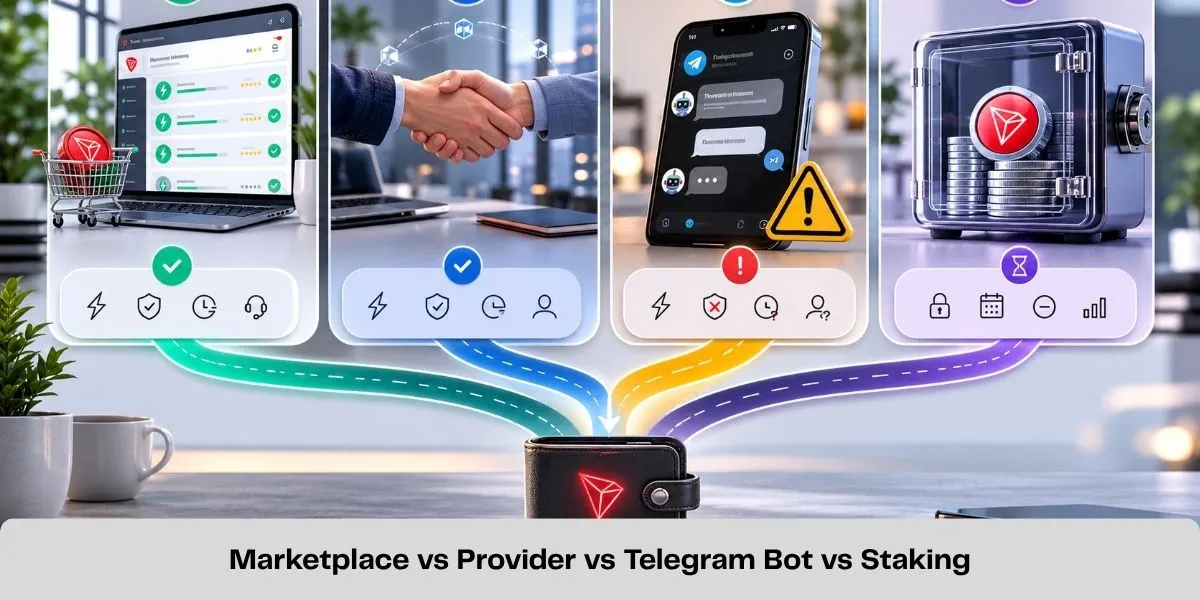
Marketplace vs Provider vs Telegram Bot vs Staking
| Option | Main advantage | Main limitation | Best suited for |
|---|---|---|---|
| Automated Energy marketplace | Transparent ordering and scalable matching of buyers and providers | Quality depends on the marketplace's fulfillment and support | Individuals, traders, payment teams and API users |
| Direct Energy provider | Potentially simple relationship with one supplier | Availability and terms depend on one provider | Users with an established, verified supplier |
| Telegram or chat bot | Convenient access | Higher impersonation, payment and support risk when the operator is unverified | Only users who can independently verify the operator and delivery |
| Stake TRX directly | Recurring self-generated Energy | Capital lock-up and a waiting period after unstaking | Long-term TRX holders with predictable resource usage |
The terms "marketplace" and "provider" are often used interchangeably in marketing. The practical distinction is whether the service aggregates multiple resource suppliers or fulfills orders from its own staking inventory. Buyers should evaluate the same core evidence either way.
Red Flags When Choosing a TRON Energy Provider
Avoid or pause an order when a platform:
- requests a seed phrase, private key or wallet password;
- asks for unlimited USDT spending approval without a clear reason;
- hides the Energy amount or rental duration until after payment;
- promises a fixed saving percentage for every transaction;
- claims every order is risk-free or guaranteed without publishing terms;
- accepts payment while showing no current availability;
- provides no order reference, support route or failure procedure;
- uses copied domains, misspelled URLs or unsolicited private messages;
- tells users to send USDT before delegated Energy is visible;
- relies entirely on unverifiable testimonials.
Price is only one risk signal. An unrealistically low quote can indicate a scam, but an expensive provider is not automatically safe.
How to Compare the Real Cost of TRON Energy
The amount of Energy required for a USDT transfer is not permanently fixed. Official TRON documentation describes approximate magnitudes of around 64,000 Energy when the recipient already has a USDT balance and around 130,000 Energy when it does not. Actual consumption can change with the USDT contract's dynamic Energy factor and transaction conditions.
Use the TRON Energy Calculator before comparing marketplace quotes.
Calculate the decision in this order:
- Estimate the current Energy requirement.
- Check the Energy already available in the sending wallet.
- Calculate the remaining shortfall.
- Estimate the TRX that would be burned for that shortfall.
- Request an equivalent marketplace quote.
- Compare total price, duration and fulfillment terms.
Do not purchase the largest package automatically. Overbuying Energy for a short rental period can erase part of the expected saving.
How to Use a TRON Energy Marketplace Safely
Step 1: Verify the official domain
Open the marketplace from a saved or independently verified URL. Do not trust a link sent by an unknown account or copied from an unsolicited message.
Step 2: Estimate the resource requirement
Check whether the recipient already has a USDT balance and estimate current Energy consumption. Treat historical package numbers as reference values, not guarantees.
Step 3: Enter the sending wallet's public address
Delegated Energy must go to the wallet that will execute the USDT smart-contract transaction. Do not enter the recipient address by mistake.
Step 4: Review amount, duration and price
Confirm the complete order before payment. Save the order reference and payment address.
Step 5: Complete the displayed payment flow
Follow the marketplace's current instructions. Never provide private credentials or sign an unrelated token approval.
Step 6: Verify delivery
Confirm the Energy balance in the sending wallet before sending USDT. If the resource is missing, use the provider's support process rather than broadcasting the transfer and hoping it arrives later.
Step 7: Send and verify the TRC20 transaction
After Energy is available, complete the USDT transfer and check its TXID on TRONSCAN.
Why TronMax Is Built for Energy Buyers and Sellers
TronMax combines a TRON Energy marketplace with tools intended to make resource purchasing and selling easier to evaluate and operate.
The platform provides:
- a marketplace for buying, renting and selling TRON Energy;
- automated resource delegation to public TRON addresses;
- an Energy calculator for estimating transfer requirements;
- public system-status access;
- API documentation for programmatic workflows;
- buyer and seller interfaces within the same resource market.
Users should still apply the criteria in this guide to every order: verify the official domain, review the live quote, confirm the sending address and check that Energy arrived before sending USDT.
When the quote and terms fit your transfer, you can buy TRON Energy directly through the marketplace.
Frequently Asked Questions
What is the best TRON Energy marketplace?
There is no universal answer based only on a brand name. The best marketplace for a specific user is the one that provides transparent pricing, sufficient availability, clear rental terms, verifiable delivery, safe wallet requirements and usable support for the required order size.
What is the difference between a TRON Energy provider and a marketplace?
A provider supplies delegable Energy from staked TRX. A marketplace coordinates demand across one or more providers and handles ordering, pricing and fulfillment. Some services perform both roles.
Does an Energy marketplace need my private key?
No. A public TRON address is sufficient to receive delegated Energy. Never share a private key, seed phrase, recovery phrase or wallet password.
Is the cheapest TRON Energy provider always the best?
No. Compare equivalent Energy amounts and durations, then evaluate availability, delivery evidence, support and failure terms. A lower quote has no value if the order is not fulfilled.
How can I confirm that rented Energy arrived?
Check the sending wallet's resource balance or account resource information through a compatible explorer or wallet interface before broadcasting the USDT transfer.
Can a marketplace guarantee the same saving on every USDT transfer?
No responsible provider should promise one fixed percentage for every wallet. Savings depend on current Energy consumption, the sender's existing resources, network parameters and the live marketplace price.
Should I stake TRX or use an Energy marketplace?
Staking can suit long-term TRX holders with predictable recurring usage. A marketplace is generally more flexible for occasional, variable or multi-wallet demand because it avoids long-term capital lock-up.
Choose Based on Verifiable Criteria, Not Marketing Claims
The best TRON Energy marketplace should make the purchase understandable before payment and verifiable after delivery.
Evaluate the complete order: Energy amount, rental duration, total price, current availability, wallet requirements, delivery evidence and failure handling. Then compare that offer with the expected cost of staking or allowing TRX to be burned.
That process produces a defensible buying decision and protects users from choosing a provider based only on a "cheapest," "fastest" or "best" label that cannot be independently checked.
Technical Sources for Fact Verification
Related Guides
How to Send USDT on TRON Without TRX for Network Fees
Learn how to send USDT on TRON without burning TRX for network fees by using TRON Energy. Check the required Energy and reduce TRC20 transfer costs.
Best TRON Wallets for TRX, USDT and Energy Management
Compare five TRON wallets for TRX, USDT and Energy management: TronLink, SafePal, imToken, Trust Wallet and Ledger with TronLink.
How Much Energy Does a USDT Transfer Require on TRON?
A TRON USDT transfer commonly needs about 65,000 or 131,000 Energy. Learn what determines the amount and how to estimate your shortfall.
How to Delegate TRON Energy with Stake 2.0
Learn how TRON Stake 2.0 resource delegation works, which resources can be delegated, wallet requirements, lock periods and how to undelegate safely.